
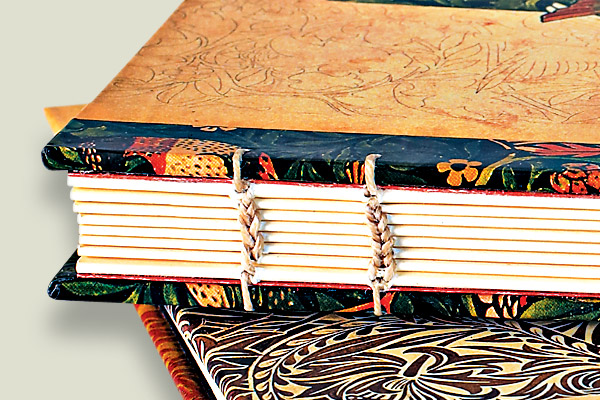
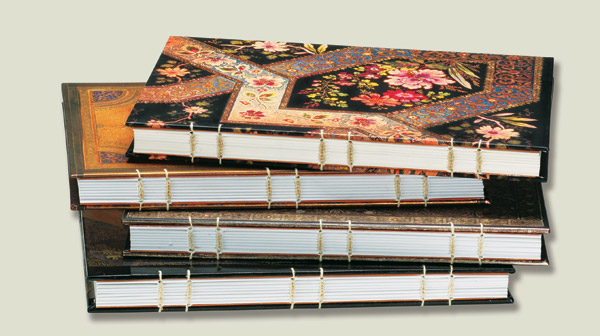
Handstitched books are rare and have become the domain of connoisseurs or those who can afford the luxury of traditional craftsmanship. The handstitched binding method – also known as Coptic binding or chain stitch binding – was first developed by the early Christians in Egypt as far back as the second century. It is a non-adhesive form of binding in which the book’s spine is exposed and the interior paper and covers are held together by a connected stitch (a chain stitch often used in embroidery).
The beauty of these books cannot be overstated, yet in our modern era they have little more than a cult following. Read on for four reasons why we believe a handstitched, Coptic-bound book should be your next journal purchase!
 1. Lay-Flat Binding
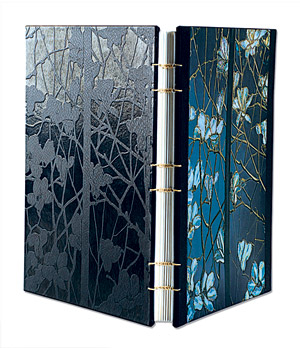
Handstitched books are heralded for their ability to lie completely flat when opened. These books can open a full 360° without damaging the spine, giving journal users unhampered access to the entirety of every page; no longer do you need to physically hold down the book with your arm or hand when using it. For this reason, Coptic-bound books are ideal as sketchbooks too. Who wouldn’t want to use a book that gives you complete, unencumbered access to the entire canvas!
2. Durability & Quality
Coptic binding is an age-old technique that remains one of the most durable forms of book binding today. It is quality, laid bare. In fact, the stitching of a finely made Coptic-bound book is likely to hold its pages in place far longer than any modern book-binding method.
3. The Beauty of Fine Craftsmanship
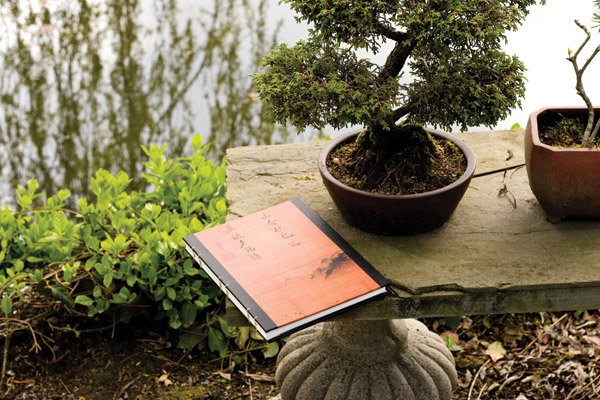
Handstitched, Coptic-bound books are beautiful! They exhibit a handmade look, which is owed to the beauty of the chain stitching and the exposed spine.
Arguably, these details can be appreciated by more than just bookmakers and book lovers.
4. A Connection to History
These books have a key connection to the history of bookmaking. Coptic binding is one of the earliest forms of bookbinding. It was first developed in Egypt in the early second century by the Christian Copts for their own texts and codices. In fact, these original books — of which only a handful have survived to this day — are so important historically because “all subsequent Western decorated leather bindings descend from [them].” The original coptic bindings were comprised of folded sheets of papyrus between wooden covers, with a chain stitch that was adapted from techniques used in carpet making and weaving.
Handstitched books are ideal for anyone who loves the old book arts and for those who love to know how things work.
Tell Us Below What You Think of Handstitched Books!
…or if we’ve missed an important point!
Paperblanks sells a range of Handstitched books that can be viewed here.
About Paperblanks: We have been producing superb writing journals for nearly twenty years. We are book people, and we believe that the written word matters and that our blank books have a critical role to play in the art and continued practice of writing itself. For more about Paperblanks, go to our website at paperblanks.com.



I have just started making some books. I have yet to try coptic though! I have to agree, handstitched books are really nice, they have a nice look and feel to them 🙂
I love these, and have been using them for years. I agree with all the author’s points. I would add simplicity to the list, as the binding is merely cord. No tape, no glue.
It is a shame that Paperblanks is only making lined journals (save for only one – and that one with a magnetic clasp) with this binding because as noted in the post, they are great for sketchbooks. Indeed, my journaling is part words and part sketch.
Hi Dan! You are correct, we are currently only selling one unlined handstitched book (though it doesn’t, as you say, have a magnetic clasp; it’s in the Tiffany Autumn Vine design). Unfortunately we’ve discontinued a lot of the unlined books over the years. But we’ll take your comment directly to our Production department!
I agree! Although I love Paperblanks, I’m very sad that there are very few unlined options. I’m a concept artist in the film and game industry – so I go through a lot of journals during just a month. When I’m forced to draw on lined ones (because I refuse to give up a pretty cover!) I have to scan the sketch and redo it on the computer before I can show it successfully to anybody. T_T
I’m sure more people would buy unlined designs, but that also means that the retailers actually have to order them! (Which they don’t as there is ONE person in charge who decides which styles to get and if he or she doesn’t like unlined paper… especially when it comes to the ultra format and hand-stitched journals… *sigh*)
I started journaling using unlined, handstiched, “midi” format. I bought a number of them when I saw that they were getting hard to find, but I am now long out of them. Lately I haven’t even been able to find midi handstiched at all. Like the others I LOVE the flat lay of the handstitched, and vastly prefer unlined.
I love that the book is flat while writing, that’s the absolutely best thing about this binding! Wishing thought, that it didn’t have to be white always…is it possible to experiment with printed edges on the back..? That would be amazing!!
Love/Cecilia ThePaperBlog
These hand-stitched books are my favorite binding for the Paperblanks range. I draw, and no other type of sketchbook, journal or notebook lies so flat. Add to that, the quality and beauty of the Paperblank products and you have nearly the perfect book for an artist!
I LOVE your handstitched books. They are by far my favorite kind of journal to use. I too would like to see more designs available with blank pages. Thank you and keep up the amazing work!
I’ve been wanting to experiment with bookbinding for a while, and when I saw the handstitching on these journals I knew this had to be my first project. I also bought the journal for inspiration – it’s beautiful. (Got any tips for how to keep the signatures lined up and the tension even while you’re stitching them??)
Hi Amy,
Thanks for the kind thoughts! Glad we could inspire you.
As for your question, we asked Wade, one of our book-binders. Here’s what he had to say: “Pre-poking the sewing holes before binding will insure the signatures line up. And the tension needs to be constantly adjusted as you stitch. The Coptic(knotted stitch) helps hold the tension as you progress from signature to signature.”
I have used your handstiched Ultra Lined Journals for several years and each year it becomes harder and harder to find them. Especially since you have such a nice selection that I would prefer not to duplicate covers if I don;t have to. I even tried to get a local store (no longer on your list I see) to order them for me one year. They were not interested.
Why can’t I order what I want directly from you? I can’t be the only person who wants your product, but is unable to find it, or unwilling to fork over $300+ US for it on Amazon or Ebay.
Hi Jackie. Thanks for writing us! Unfortunately we have no plans to sell directly to consumers. You say you’ve tried local stores but have you tried our online store list? (http://www.paperblanks.com/stores) Where are you located?
I love Paperblank journals and have been collecting them for years. I am now ready to try one of the coptic-binding journals after reading about how well they lay completely flat.
I have a collection of many years of beautifully printed quotes I design on the computer, with beautiful calligraphic fonts and marvelous images from Aridi.com. I am hoping that the Linda Gospel journal with coptic binding will allow me to insert the quotes into the book. The Linda Gospel journal is probably the only one that can do justice to the beauty and power of the well-written word. I can’t wait to get started!
If the coptic binding isn’t the best one to use, do you have another journal that would accept printed papers inserted into it?
Someone said they are getting hard to find online… I found a whole range of my favorite Lindau Gospels, including the coptic binding, at http://www.misterart.com/ with very good prices, too. Heading there now!
Thanks for this great blog with conversations and more. One more reason I love Paperblanks, keeping the world of beautiful bookbinding alive, in a world of electronic “etherness.”
Bless you in all your endeavors, bringing the Divine to life!
“The winds of grace blow all the time; all we need do is set our sails.”
Dear God please show us The Way.
Hi Catherine,
What a great idea for using the coptic stitch journals! We currently offer the Handstitched and Smyth Sewn options, so for the purposes of printing sheets and adding them back into the journal, the coptic is probably your best option. However, all Paperblanks have a memento pouch at the back, so if you are inspired to print any papers and don’t want them to fall out, that’s a great place to store them!
Thanks, as well, for sharing Misterart.com. It does look like they have a great selection!
As for your question about the blog being updated – we are indeed still here! Though this particular article is a few years old now, we are posting new content four days a week! Check out our homepage http://www.blog.paperblanks.com for all the lasted updates.
All the best,
The Paperblanks® Team
I hope this blog is still being updated… I notice the last entry before mine is from 2012. Anybody out there?
Thanks for sharing your info. I really appreciate your efforts and
I will be waiting for your next post thanks once again.